
I know speaking for myself I find it all quite confusing at times and I have for some time, been meaning to write down as many of the useful numbers of fly-fishing in one place as much as an aide-memoir for myself as anyone else. That said you might find this stuff useful too.

Standards
Let’s start by talking about standards for a second. In the industry I work in, (Telecoms) Standards are EVERYWHERE. Everyone’s mobile phone needs to be able to work with any manufacturers network operating in the same system. So a Sony Mobile phone has to be able to work with a Huawei Base station and an Ericsson Core with some Nokia bits in there too. And when you move to another network operating the same service that uses say Nokia Siemens Base stations and a Huawei Core, you would expect your phone to play nicely there too.
Sadly, though at first glance, it might appear fishing tackle has standards, it really doesn’t. It has broad ranges of sizes, weights and dimensions that manufacturers quote but there is no guarantee that Airflo’s 6# line will correctly load a Greys 6# rod . Or that Kamasan’s size 16 hook is the same size as a Partridge size 16 hook.
It is all VERY frustrating. If you live in one vendor’s domain no doubt all your fishing tackle co-exists beautifully. However how many anglers use one manufacturers equipment? Only those fortunate enough to be on the “Pro-team” or those sponsored to use one makers kit. The rest of us mere mortals mix and match our Wychwood reels with Greys rods, with Cortland Lines and Fulling Mill Tippets.
Then sometimes getting it all to play together nicely isn’t that easy. A personal example I encountered was that I have a Daiwa 6# rod and wanted a suitable line to pair with it. I was recommended a Greys Platinum WF floating line in a 7#. I spooled this onto my Hardy’s Ultralite CLS5000 ( note this reel is supposedly designed for up to a 5#weight line but I personally find it more than big enough) and the outfit cast beautifully. I received so many compliments on what a balanced outfit it was, I know at least two people who went out and bought the same set up.
Then I needed to replace the line ( it got damaged) and Greys in their wisdom changed the Platinum range of lines. I bought what I was told was the direct replacement for the line I had and it casts like a sock tied to a length of string. Totally unsuitable for the rod, and I have had to do a lot of experimenting to get back to something at least as good as what I had.
So in short we can’t always trust the numbers on the gear we buy and one make’s size X is another’s size Y.
This page I hope, helps relate some of the numbers around fly fishing to each other and make some sense of the madness.

The X Factor
Very possibly one of the most confusing systems that appears to be a standard but as far as I can tell, isn’t, is the X rating system for fishing line- tippet material.
It is very popular in the USA and Stateside anglers rarely refer to breaking strains of nylon tippet, they refer instead to the X rating of the line in question.
As far as I can tell the rules are not hard and fast but there are some useful rules of thumb when working out what someone means when they say, they use a 2 foot section of 7X tippet, or their tapered leader ends at 4X.
Lets start at the beginning, and the United States’ ongoing love of Imperial measures. In times where pretty much all the rest of the world has moved on to Metric measures, even here in the UK where “Empire” was defined, the USA who pride themselves in revolting against the Empire in 1776, continue to keep using miles, gallons, inches, feet, lb’s and ounces. So when they measure very small stuff, they do so often in “thou” or Thousandths of an Inch. This is the starting knowledge you need for an understanding of how the X system works.
You start with the number 11 and for each one you subtract, you increment the diameter of the line in question by 1/1000th of an inch. The below table explains, but please note though I have shown the equivalent in mm, the system was designed around inches, so this is just for reference here:
| X Rating | Line Diameter (inches) | Line Diameter (mm) |
| 11 | 0 | 0 |
| 10 | 0.001 | 0.0254 |
| 9 | 0.002 | 0.0508 |
| 8 | 0.003 | 0.0762 |
| 7 | 0.004 | 0.1016 |
| 6 | 0.005 | 0.127 |
| 5 | 0.006 | 0.1524 |
| 4 | 0.007 | 0.1778 |
| 3 | 0.008 | 0.2032 |
| 2 | 0.009 | 0.2286 |
| 1 | 0.010 | 0.254 |
| 0 | 0.011 | 0.2794 |
X Rating to Breaking Strain
This is where things start getting a bit messy. As a RULE OF THUMB you can apply the following logic, the rule of 9.
“Subtract the X rating from 9, to get the breaking strain of the line”
As a rule of thumb this gives a reasonable guide as to what breaking strain of tippet material might be in use when an angler states, I am using 7X. Take 7 from 9 and the answer is 2…. as this is an entirely Imperial based system, that’s going to be 2lb’s.
The following table expands this further. However I will be VERY careful to reiterate, this is a rule of thumb for quick and dirty calculations. Practically no maker makes line of the exact diameters stated previously, they are all ballpark measures, and the stated breaking strain’s for some diameters vary wildly across different materials and makers line ranges and claims of strength. Once again, the system is entirely Imperial and include metric conversions for completeness based on the Imperial Breaking Strain.
| X Rating | Breaking Strain (lb) | Breaking strain (kg) |
| 9 | 0 | 0 |
| 8 | 1 | 0.45 |
| 7 | 2 | 0.9 |
| 6 | 3 | 1.35 |
| 5 | 4 | 1.8 |
| 4 | 5 | 2.25 |
| 3 | 6 | 2.7 |
| 2 | 7 | 3.15 |
| 1 | 8 | 3.6 |
| 0 | 9 | 4.05 |
So it won’t surprise you to know, actual stated breaking strains for reported diameters of lines are all over the place. And to make matters worse it is VERY hard to get all this info in one place so you can make a direct comparison. Bizarrely some manufacturers quote the X rating on some of their ranges and not others, and some quote only metric diameters in mm’s which is quite hard to relate to X ratings unless you have a gift for mental mathematics.
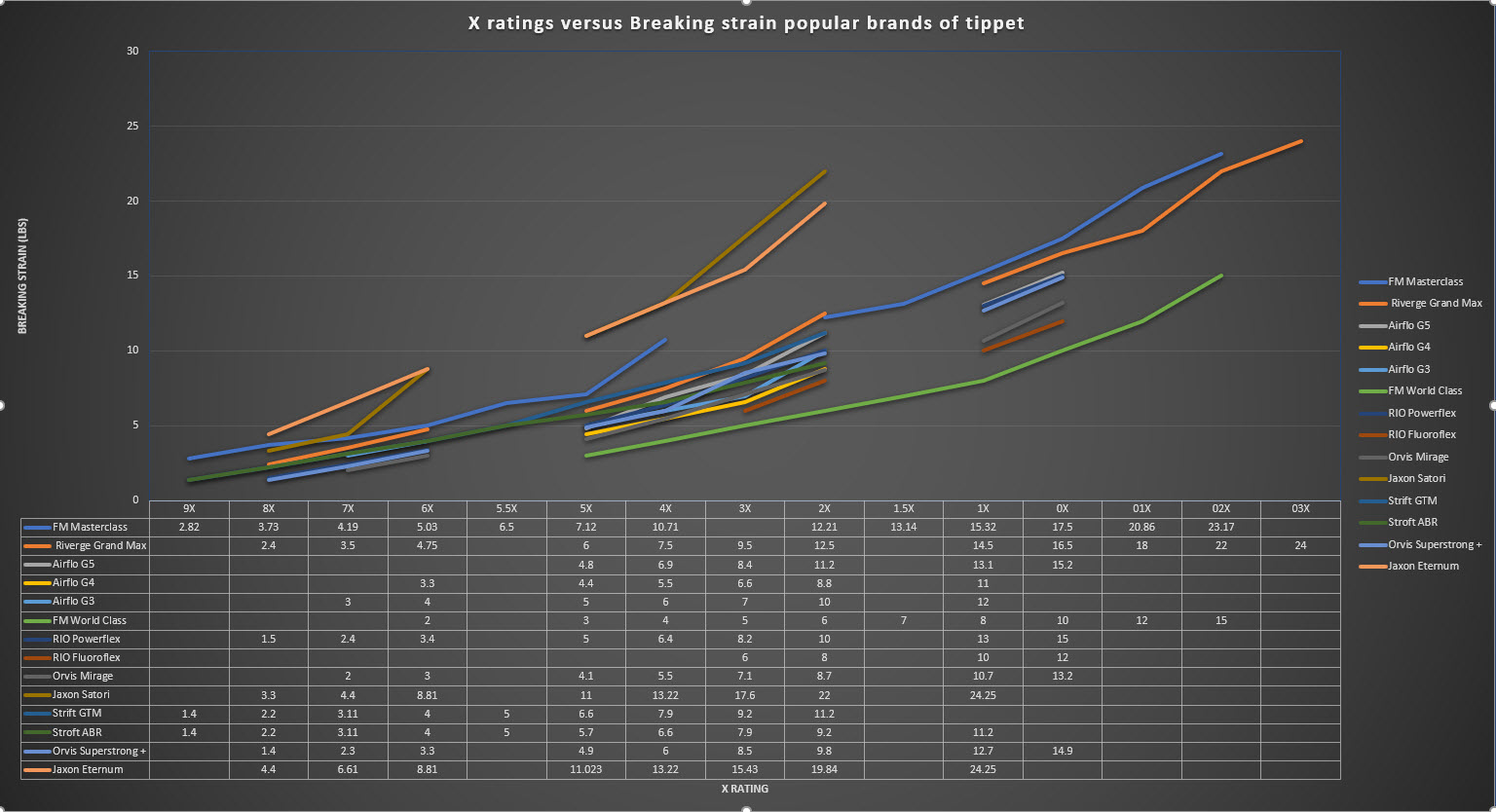
So I have spent a fair bit time gradually pulling together all the diameter, X rating and breaking strains of popular tippet materials available now ( June 2019) and tabulated and graphed them for comparison. As some vendors quote all the dimensions and options themselves and some don’t and very few tackle shops offer the information in easy to interpret formats, this has not been a two-minute exercise. It has involved visits to manufacturers websites ( some are truly horrific….did someone say Froghair?) and some quote partial numbers in one range and none in others- Fulling Mill Ahem! I have had to resort to looking at photo’s of some spools to get the sizes and eventually put this table together.( I gave up with Froghair entirely by the way).
Jaxon and Stroft, two popular EU makers of monofilament and fluorocarbon only quote mm diameters. So in these cases I have had to make my own guess as X rating based on the rule of 11ths as much as possible. The maker Fulling Mill also quotes some lines in 1/2 sizes on the X scale- I have no idea if this is an accepted measure but I just had to go with it and for some of the European tippets could only make their range fit the scales using the half sizes.
Some makers, notably Jaxon quote quite extraordinary breaking strains for some very fine tippets, as I have no experience with the stuff I cannot say if they are truthful. The descriptions on the maker’s site are such poor English I can only say it reads a bit like there are a few get out clauses in there buried in badly translated text, in case you have issues with break offs. How they are achieving these ratings in such fine diameters and no one else is coming close I cannot say.
Tippet Comparison In Summary
The outliers Jaxon claims some very high breaking strains to line diameter ratings, and Fulling Mill World class “supports” the rest of the field at the bottom end. Fulling Mills high end “Master Class ” tippet tops the rest of the brands in general once you remove Jaxon. All the rest seem much of a muchness. I have used Fulling Mill World Class, Air-flo G3 and Stroft in most of my fishing with the odd time using Rio Powerflex. I haven’t had much issue with most, maybe I have had more break offs with Airflo G3 but that is probably because I have used it the most. I have very rarely been broken – have I ever? not actually sure when I think about it using Fulling Mill World Class which might suggest their breaking strains are quite conservative.
Stroft I like for my river fishing and mostly find it OK though the odd batch can be temperamental for some reason, maybe a Quality Control issue there, the stuff I am using just now has been fine. If you have an opinion please share it in the comments below( keep it polite and truthful!)
Some more numbers: tying knots
So now you have your different diameters of line what can you tie to what? Again a pretty reliable rule of thumb applies when tying two sections of tippet together of different diameter. As a rule you should never use different diameters that vary more than 2X ratings. So if you have a piece of 4X tippet ( roughly 5lb ) and you want to attach it to a finer section say for a dropper or a tapered leader, the piece you tie it to should not be smaller than 6X ( 3lb) going towards the fine end and if working back towards the a thicker section and your main line, 2X or 7lb ish. So going from 4X to 1X would not be clever, you are asking for issues with knot strength.
Fly sizes and tippet diameter
So now the relationship between fly sizes and the tippet you tie it to. It is worth saying right off, this is a rough rule of thumb and there is a lot of latitude around this one. The concept here is what size of tippet gives the best presentation of turnover of what size of fly. There are an awful lot of caveats. Not least the following:
- Target species
- Size of target fish
- How aerodynamic is the fly
- What weight of rod is in use
I will expand on these in a minute once we cover the rule. So in this one you divide the size of the fly hook by three and the result is the optimal X rating of the tippet for that size of hook. Lets look at some examples.
You want to fish a size 12 wet fly for Brown Trout, so 12/3=4. You can use 4X tippet ( roughly 5lb) and get good presentation.
You are fishing for spooky river Brown trout and need to fish a size 24 midge pattern: 24/3=8 so you need to be using 8X or 1lb-2lb line.
| Tippet diameter | Fly hook size range* |
| 0X | #1/0 to #4 |
| 1X | #4-#8 |
| 2X | #8-10 |
| 3X | #10-#14 |
| 4X | #12-#16 |
| 5X | #14-#20 |
| 6X | #16-#24 |
| 7X | #18-#28 |
| 8X | #18-#28 |
*Optimal but dependent on some other factors as discussed!
Un aerodynamic flies: Fishing a size 16 F-Fly or beaded Nymph on 4lb mono line ( 5X ) will likely be OK. But what if the fly is something like a size 16 daddy longlegs with a big hackle and legs and wings. I will tell you what will happen, if you are just casting and not actively covering fish in front of you ( ie. fishing blind and searching out fish) so you cast, wait a few seconds, false cast a few times and then cast again…. within 4 or 5 casts I guarantee your tippet will be all coiled up around itself, as the fly spins in the cast. The solution is usually to employ stiffer or thicker tippet material, maybe try a stiff fluorocarbon in a similar diameter, or a thicker nylon….it is a trade off. That or cast less and keep a close eye on your line and fly.
Hooks
I am not going to go too deeply into hook sizes as it is simple a bewildering subject. Obviously, hooks have different shapes based on their purpose in fly fishing, and this influences their size to some extents. But it is clear that different vendors and makers apply entirely different criteria when it comes to measuring their hooks. It is not as simple as merely the hook gape, or shank length that provides comparable dimensions to be able to compare one make’s size 16 hook with another.
Were that it was so simple.
Frankly I have no idea, none, zilch, nada, what determines a manufacturers size rating for a given hook. Within a makers ranges you can reasonably reliably expect to compare their size 16 with 14 and know that the 14 will be bigger than the 16. Step between makers and you can be in a whole world of hurt.
This photo shows the extent of the problem. It shows size 16 hooks from different makers compared. Yes, there are variants here from straight eyed “specimen” hooks to deeply curved Klinkhammer emerger hooks but feel free to comment if you can fathom why they are all rated as #16.
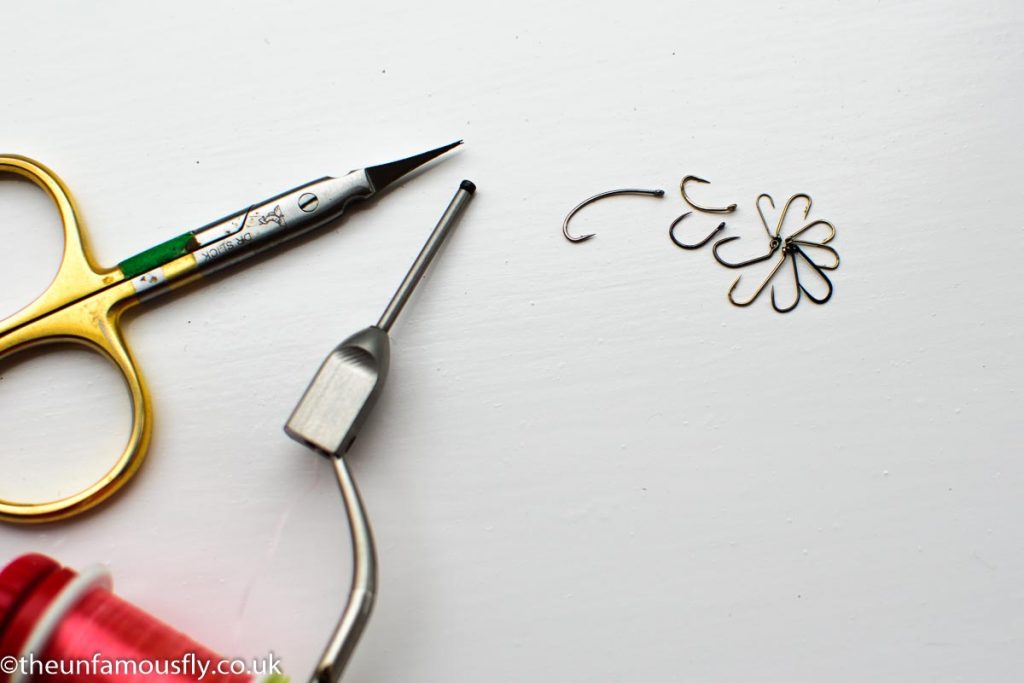
All these hooks are rated as size 16’s. Setting aside the different “styles” for a second, it is difficult to work out what dimension was used to determine the reason for the rating.
Fly Lines
Grains, Line Weights and Sink rates
I think most anglers “get” the line weight system used in matching fly lines with fly rods, and to a lesser extent fly reels. In general and within the limits of common sense, fly reels are very much down to personal user preference.
You shouldn’t maybe be putting a 7 weight line onto a reel rated for 2/3 or 3/4 weight use, the head of the line is going to fill up that spool so much it is unlikely you will be able to fit any backing. However speaking for myself, the reels rated for 7 weight outfits always seem overly large for my needs and I tend to use reels rated for 5-6# lines even when using a 7# line. It increases my flexibility in what rods I can use a reel with ( especially cassette type reels) and I feel I can fit more than enough backing for my purposes ( normal trout fishing). If you maybe fish for salmon a lot in smaller rivers or for light seawater use, I can understand why you might want a larger reel for a 7# rated line as backing might become an issue with generally more powerful fish. Consider your use and your quarry and scale your tackle accordingly. Like I say- common sense.
Line Weights
So coming back to line weights, most trout anglers are familiar with getting a 6# line and pairing it with a 6# rod. That would be the basic starting point for any balanced outfit. For more surety when taking this approach, buying the same brand line as your rod should give you a fighting chance that the rod was tested with that very line when being assessed for what weight rating it should be rated at.
This is all though very much personal preference. In the UK, in particular, it is very common to overline rods, especially in the competition Stillwater scene. Fishing a 7# line on a 6# rod would in no way be regarded as abnormal. Some might even go two line weights over the rod rating.
I can’t help noticing that in recent years rods are almost all rated at single weights, whereas in the past a rod might be rated over as many as three weights. I still have a Carbon rod rated at 5#-7#!
Often it is very much a case of find something you like with the rod you use. I have a mixture of 6#lines and 7# lines for my 6# rod and have on occasion used a 7#line with my 5# with no issues. Most modern rods will cope with most line weights though go too heavy and you will find it will cast like a wet sock tied to a length of string. Especially a softer/slower actioned rod.
With floating, sink/midge-tip and intermediate lines it is probably wise keeping close to the line rating of your rod when choosing a line. With sinking lines, it is less of a precise science. Sinking lines, especially very high sink-rate lines, don’t cast particularly elegantly and you can manage the weight of a “too heavy” sinking line by shortening the aerialized line during casting, to make it work with a lighter rated rod. Casting starts to become more like lobbing with high density lines.
Grains
While we tend to use Line weights that simply match a fairly standard range of rod weights in trout fishing, you might also encounter line ratings measured in Grains. Especially when moving to Salmon or salt water branches of the sport. Grains is another of those rather esoteric measures a bit like “Cups” used in cooking in recipes from the US! However, 1 Grain has a very precise measure of 64.7989 milligrams. It is based on the ideal weight of one “virtual” grain of cereal of ideal size.
When lines are rated for their weight it is done over the first 30 feet of line and so it is with Grains. The Grain weight is the measured weight of the first 30 feet of fly line. Due to manufacturing, there is some tolerance allowed in this though and so you will want to experiment with lines and rods to get your ideal pairing for your preference and purpose.
The following table ties together line weights with grain weights, tolerances and conversion into milligrams. A side note, if you have ever cast a heavier rated rod, say a 9# and thought how much heavier it feels than say a conventional 7# you aren’t imagining it. Look at how grain weights increase with size and increase more as line weights increase.
| Line weight | Grains | Tolerance | Milligrams |
| #1 | 60 | 54-66 | 3887 |
| #2 | 80 | 74-86 | 5183 |
| #3 | 100 | 94-106 | 6480 |
| #4 | 120 | 114-126 | 7776 |
| #5 | 140 | 134-146 | 9072 |
| #6 | 160 | 152-168 | 10368 |
| #7 | 185 | 177-193 | 11988 |
| #8 | 210 | 202-218 | 13608 |
| #9 | 240 | 230-250 | 15552 |
| #10 | 280 | 270-290 | 18144 |
| #11 | 330 | 318-342 | 21384 |
| #12 | 380 | 368-392 | 24624 |
| #13 | 450 | 29160 | |
| #14 | 500 | 32399 | |
| #15 | 550 | 35639 |
Note: “Normally” line grain weights refer to the head or first 30 feet of line but refer to the manufacturer’s datasheet to confirm this is, in fact, the case for any product as some do vary this.
Sinking lines and Sink Rates
The days of having a floater, intermediate or sinking line to choose from have long gone. For most river, trout fishing applications a floating line of some sort is all you will ever need. If you want to fish Euro-style you just make a suitable leader and fish with the fly line just outside the tip of the rod or indeed if you have tied on a French Leader, the line stays on the reel. If you are fishing more conventionally, and need a bit depth, simple loop to loop Poly-Leaders are really all you need to get the fly down a bit more.
For Stillwater and Seawater applications however subsurface lines come into their own. When bank fishing or wading in Stillwater, Sink-tip, Slow or full Intermediate and Full sinking lines are all you really need. As in river fishing you can eschew a sink tip by using a Poly Leader and arguably a slow intermediate could be dispensed with using one of these too. However some methods require you get your flies down deeper and a Full Intermediate or for those who have not got the patience to wait on the Intermediate sink to the depths, a Full Sinking line are useful.
Boat fishing
If fishing in a boat at anchor on Stillwater arguably this same combination of lines too, is all you need, for Seawater where the depth can be great, something that will sink faster may be appropriate. Plus the line may need to cope with currents and tidal flows that may have the effect of slowing or even stopping a line sinking unless it has sufficient density. (Bear in mind also that salt water is denser than freshwater, so a line rated to sink quickly in freshwater will be slower sinking in the sea.)
For Loch Style fishing though where the boat is moving ahead of the wind, the need for fast sinking lines becomes apparent. Add to this that in Competition fishing, sometimes the addition of artificial weight to a fly is forbidden so the line is the anglers only means to control depth.
The system used to categorise sinking and fast sinking lines is based on how many inches per second or “ips”, a line sinks at.
In the UK we tend to refer to the Di nomenclature which as far as I know is Airflo’s naming convention. I think the D probably stands for Dense or Density, the “i” is inches per second and the number is the sink rate. Airflo are probably the most popular brand of lines amongst Stillwater Anglers here. However other brands have their own names but they use the same unit of measure i.e. inches per second. Scientific Anglers call their lines Sink # where the number # is the ips. Orvis ( actually the owners of SA) call their fast sinking range “Depth Charge” lines and quote sink rates in ips. Greys just refer to Sinking #ips and other vendors and brands in the Trout fishing ranges stick to this. Anglers here though, regardless of the brand will often just call it a Di#.
Intermediate and standard sink rates
An intermediate line is basically a lower density sinking line and they usually come in sink rates from 0.5ips (slow Inter) to 1.5ips ( Fast Inter). A standard sinking line is typically 2 ips. Then the faster lines come after this.
The Di or ips sink rate tells you nothing about the lines weight which will still be scaled according to the rod you want to cast it with ( though bear in mind as you get denser lines the casting becomes significantly less elegant and so the weight maybe matters less).
Tolerances
As far as I am aware, the sink rates quoted are “averages”, and are influenced by a number of factors. One manufacturer states that a Sink 5 for instance will sink pretty well exactly at 5ips when used in a 7# line. The same vendors 5# line also in a Sink 5 will sink slightly slower at no less than 4.5″ per second and say a Sink 8 will sink slightly faster that 5″ per second but again no faster than 5.5″ per second. In other words they have to allow a degree of tolerance in the manufacturing processes.
Add to this that no sink rate can account for differences in water density and pressure, currents and tides. Also, a 5ips line for Saltwater use if used in freshwater would sink faster or conversely a freshwater Di5 would not sink at 5″ in seawater because Seawater is denser due to salt.
The T System
Finally this brings me to mention the T system of rating lines. This system tells you very little at all about a line. The T refers to Tungsten and how many Grains of Tungsten are present per inch of line. Sinking lines are made sinking by impregnating the plastic coating with tungsten powder. The more Tungsten the faster it should sink. You can therefore assume a T4 won’t sink as fast as a T8 and with like for like density and diameter of line this would be the case. However, in a theoretical world you could make a T4 line with low enough density that it floated but still had 4 grains of Tungsten per inch! It does appear to be used though by some vendors of shooting heads and detachable Sink tips so it is worth mentioning, just make sure you read the ips rating of f the sink tip or shooting head in this case.
Download
You can download the tables included in this article to have as a handy reference or use as you wish.




Great article!
Thanks for your kind comment.