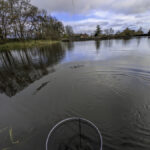
I was up to Loch Coulter last night for a spot of fishing as the sun went down around the summer solstice. The days aren’t going to be getting any longer anytime soon!
I spoke to one gent who was it seemed just heading out to fish from the bank. He was saying there were plenty fish but were very hard to tempt and hard work. That didn’t sound great but standing talking about it isn’t catching fish, or for that matter getting a boat organised.
I did notice the loch is very full, the water level is right near as high is it can go, which is surprising given the relatively dry spell we have had, I recall last summer the water level being much lower.
Once out in the boat I moved up into the shallows along the dam and got some flies tied on for the drift down the wind, but it was blowing so hard that I was down to the boathouse level in the time I had them ready. A couple of bushy snatchers and one of Tommy’s wee midge patterns on point.
I decided to fish anyway there were hundreds of yards of water in front of me. A fish moved immediately to my right and I tried to cover it, but even though it wasn’t far the wind took the power out the cast and it lande din a heap. Another moved, again to my right, then another….. I decided to about turn and try tuck the boat more in to the right and be able to get to where there were clearly fish. As I motored back up wind more fish moved on that side ( my left at this point ). Right a the top of the wind there was actually hardly any, ( wind that is) . In fact there were a lot of fish rising but in the margins. You couldn’t hope to fish for them on a team of wets. The margins here, are not some reedy distinct cut off between shore and water. They are quite a significant area of mats of floating tangly weed with big gaps between. You could fish a dry-fly in between but only one and would need to be prepared for a snag while recovering any fish hooked. I decided to take that chance. I changed to a dry , a wee black ‘Bits and started to cover some of the rises where they seemed to be in reach. No takers after 20 minutes so time for a change. Fish were moving now out on my left, much the same area as I initially spotted them, but I was tucked right in now. I noticed a few small sedge and wondered if they might work, so tied on a favourite pattern, the LTD Sedge. The fish were not rising steadily, but one here, one there, nothing consistent. A fish rose right out a good distance away, and I wasn’t sure I could reach it with any accuracy but gave it my best double hall. I amazed myself when the fly landed about a foot from where the fish had shown, the evidence was the still receding circles…. I waited about 3-4 seconds then the fish rose, I lifted and….. nothing, it didn’t connect or I missed it. At range dry-fly is never easy but I don’t think I ever touched the fish.
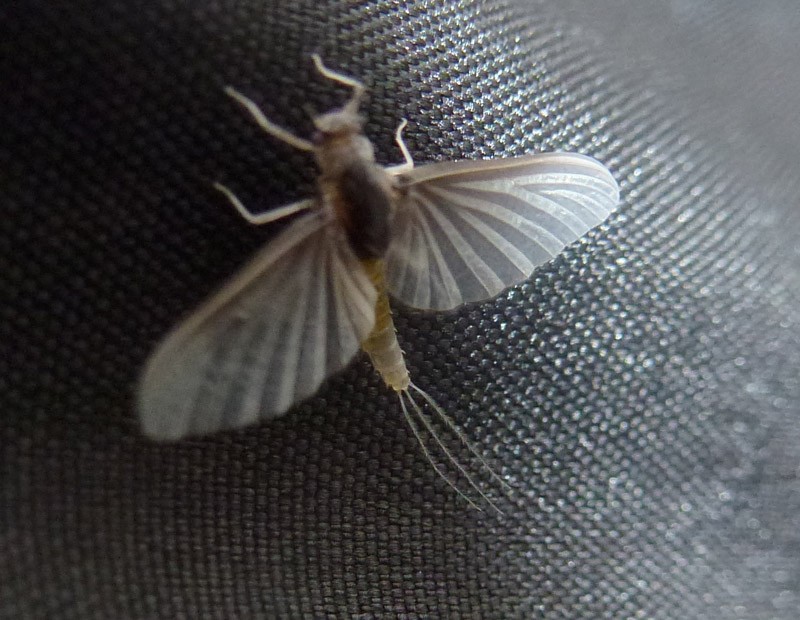
Close up caenis- this is what you are up against
I drifted right down, and never turned another fish and was pondering my options. I decided to putter across to the burn entry area. The one other boat that was out, had left that area some 30 mins earlier and was back near the moorings now. Down near the burn the water was flat calm and there were lots of fish rising, but the focus of their attention was clear, Anglers curse, the Caenis. There were tons of them littering the surface.
I tried the sedge in amongst the pockets of rising fish but the fly was neatly body swerved All except that is on one occasion. I seen a fish move and cast to cover it. As the fly dropped to the water, the fish rose, directly under the dropping fly. The fly pretty much hit it on the head, there was a double swirly, I wasn’t sure if the fish had taken or not, but I lifted…… not.
When fish are cruising sipping midges like this you need to be aware that its angle of vision is so narrow. If you have ever read the “Trout and the Fly” the classic Clark and Goddard book, you will be aware that close to the surface the fish can only see in a very narrow field of view above them, if you don’t land the fly in that field of view you aren’t going to catch. I tied on a miniscule size 18 Caenis/midge pattern and readied to cover what fish I could target.
Almost on cue the rises stopped, then started again, deep in the tangle of marginal plants. But there were others now right across the other side of the bay so I slowly motored over within range. The rise was intense, it looked like fish were competing to hoover up as many of the tiny flies as they could. What seemed on the whole a steady rhythm of sip… swim… rise… sip… swim… rise… sip, would increase as two fishes got closer sip.. swim.. rise. sip. rise. sip rise. But putting the fly into this maelstrom seemed to either result in them stopping or avoiding it. The rise would stop before the fly and start again behind it. A fish rose right in near the margin and I cast into the fading light to cover. It was incredibly hard to see with the glare of the setting sun right in my face. I did put the fly as near to the fish as I could see, and waited for it to move towards the fly. Closer and closer it came. What happened next was very confusing. There was a sip near my fly, but was it my fly or not, I really couldn’t tell, it looked like my fly was still there. I then felt a slight drag on the line and I lifted and yes, it was hooked. A fat fish of around 1-1 and a quarter pounds, it gave a good account of itself sitting hard on the bottom then leaping to the surface. The barbless hook came out easily as I brought it in to the side of the boat and used the unhooking tool to let it go.
Enough, time for home, I felt I had achieved all I was going to tonight.