Long Weekend
This weekend it was my wife’s birthday. Planning ahead some time ago, I had booked a couple of cheap flights to Milan, Italy for a weekend city break. I won’t bore you with the site seeing around Milan. However on Saturday we walked down the West side of the city centre and in so doing, stumbled across a shop, called Fly Fishing Ghilardi.
Fly Fishing Ghilardi
The shop seems to sell for the most part, outdoor gear rather than much in the way of fishing tackle, but the owner Sandro Ghilardi was very welcoming and has been a life long fly fisher. If I understood him correctly he has fished for 77 of his 82 years!
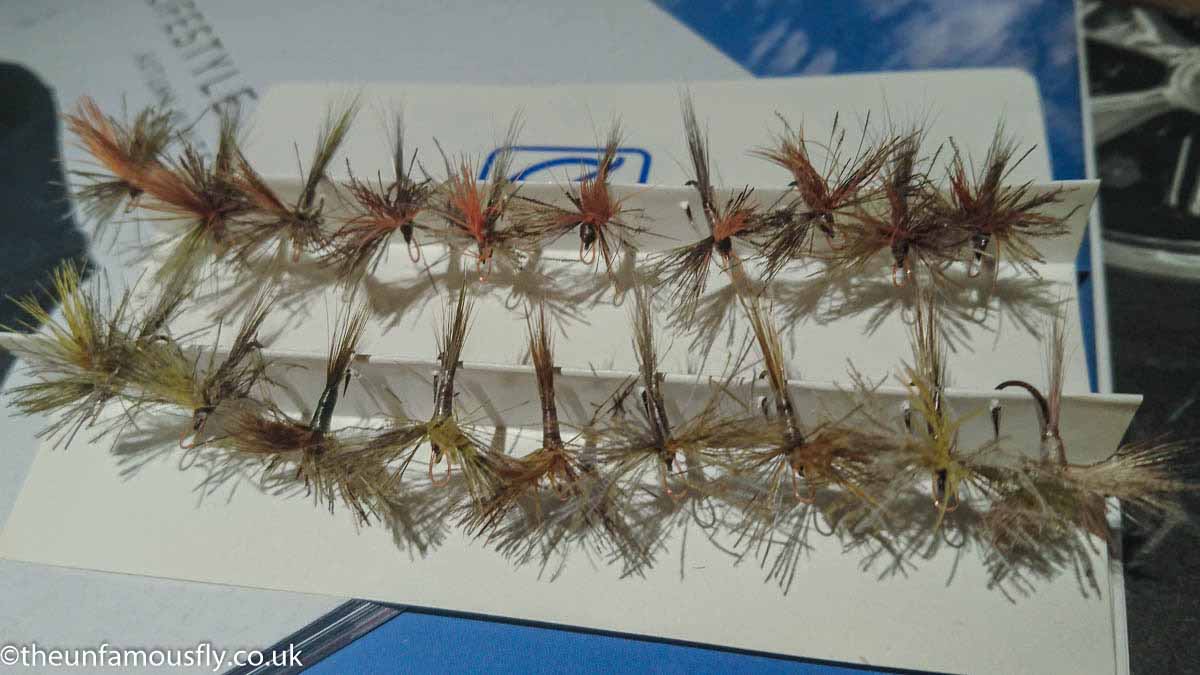
A selection of Sandro’s flies
The Language of Fishing
I don’t speak any Italian, apart from Ciao, Per Favore, Grazie and Prego! Sandro’s English, while better than my Italian by a considerable distance, was not fluent either, but the pair of us made the best of a bad job and communicated in the language of fly fishing.
While the shop didn’t appear to have a lot of Fly Fishing kit visible, apart from a rack of rods at the door, it appeared like the back room was a fly tying workshop of sorts, with drawers of threads and various feathers strewn about the bench I could see. When I told him I was from Scotland he related to me that he had fished in England. He had fished as far north as the River Eden. I was saying that I fish just over the border on the Annan. He appeared to know of it and the Brown trout and Grayling there.
Dry flies
Alesandro was keen to show me his flies. He told me he is pretty much exclusively a dry fly fisherman. The flies he uses are what I would term “split wing” styles, with a bushy wing either side of a slim low resistance body. Sandro was keen to impress on me that the flies had no hackle to press into the surface film and no dubbing. Dubbing stopped the body of the fly sinking below the surface. The bodies were either varnished or used UV resin for a slim profile. The tails were pretty heavily tied in with maybe 8-10 strands of what I think were Coq de Leon fibres.

Detail of the flies, with the characteristic loop eye tied in, in mono
Uniquely he was showing me that he crushes the eye of the hook and replaces it with a loop of monofilament to tie the hook to the tippet with ( Not unlike traditional Tenkara flies) . This he explained ( if I understood him correctly) was to prevent break offs with the line at the eye of the hook . I assume the loop cushions the take but also provides for a more natural presentation. The wings of his flies were a mixture of CDC and dyed Mallard Duck Breast feathers. These were dyed to help as sighters for the flies in fast mountain water where he said he pretty much exclusively fishes. The flies seemed to be what we here would regard as Mayfly patterns though one was a variant of the Royal Wulff with the split wing and nylon eye.
I took a few photos with my phone as I did not have a lens suitable for macro work with me on this occasion on my SLR, but hopefully they are clear enough to see.

Close up on flies
1970’s film
I was doing a bit of an online search to see if I could see any videos by Sandro of how he ties his flies. While I didn’t, I did come across this old film. I am pretty sure the “young” shop assistant is Sandro and the shop scene is set in the store we visited on Saturday, though it’s clearly changed a bit over time.
The video shows fishing of the ‘style’ I assume Sandro still uses, and there are some pretty epic trout harvested from the gin clear streams. The film being in 1970 isn’t going to show catch and release! The fish caught were clearly all for the pot. Different times, so if that bothers you maybe best not to look. I thought it was great.
You can look Sandro up on Facebook where he posts more pictures of his flies.