My present for Christmas this year was a Tenkara rod, something I hope to be able to have a go at in the new trout season. I have heard of anglers fishing Tenkara for Grayling in winter but I will leave it for the Brownies in March+. Being on call this weekend, getting out fishing was not really an option so I decided to have a wee shot at practicing casting with the Tenkara rod. Given the realtively short, and fixed line this is something I can practice in the garden, just to get a feel for it. Plus, trying something for the first time on water is rarely a good idea as you won’t get it right and will probably spook any fish thus denting your chances of catching.
I tied up a wee white Tenkara style fly and chopped the point and barb of the hook of so it had pretty much the mass of a fly but wasn’t going to hook into anything in the garden and get stuck. White would allow me to see it in the drab grey, flat light we currently have this time of year.
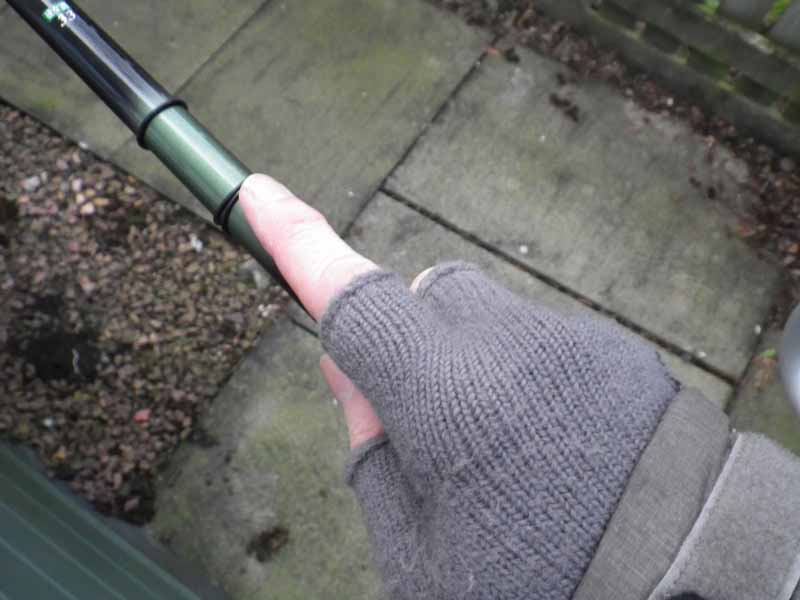
The correct Grip for Tenkara style fishing. I have been doing it this way anyway for years.
I have been watching a few Tenkara videos on the web which explain the methodology behind casting. Fortunately the recommended grip which is first finger up the handle pointing at the tip, is the grip I tend to use conventional fly casting anyway so this element was easy for me. (head off at the pass 1: don’t bother telling me I should cast with my thumb pointing to the tip on a conventional rod- in an ideal world I would but I have always had wrist problems over the years and a conventional rod grip causes me these problems over a fairly short period- and no its nothing to do with the Arthritis either!).
The idea as I understand it is to shorten the cast to something like a 10/11- 1 o’clock range. So shorter than a conventional fly rod cast of more like 10-2 (head off at the pass 2: I know there are all sorts of other methods and arguments- but this is by way of explantion so you get my drift!). You also want the fly as I understand it to try land first so there should be little or no line on the water. This improves presentation and stealth. I set up the rod I got, its a Shimotsuke Kiyotaki in a 7:3 format and 3.3 meter long length from tungsten-beads-plus.co.uk .
I will put up more of a review of the rod on my tackle pages when I have had a chance to fish with it hopefully in the spring. I got the rod with an accessory pack so it gave me a chance when setting it all up to work out how this works. The line keepers that fix over the rod are a clever idea, two cam levers which give you somewhere to loop your line over while moving from spot to spot with the rod collapsed.
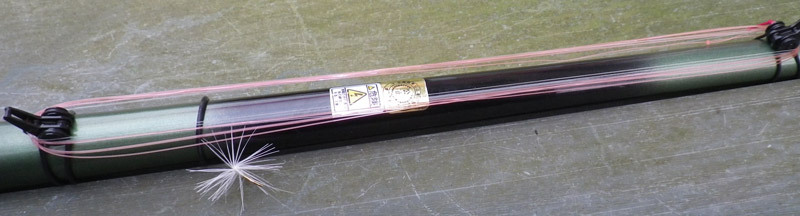
Rod collapsed with line holder doing its job
When you see one of these rods in its collapsed state it sort of looks like a bit of a toy however once its set up and fully extended it feels like a proper conventional fly rod. Its not heavy- I think they say 66g on the website but I would be a liar if I did not say it felt heavier than I expected once fully extended. It has a reassuringly solid feel to it. I think this comes about through the length as at 11 feet or so its a fair bit longer than any of my fly rods. While you don’t have the weight of a reel the flip side of this is that you don’t have the counter balance effect of the reel so I think its maybe this you feel.
I bought mine with a level fluorocarbon main line. When you attach the line to the lillian ( the string fixed to the tip of the rod) the idea is that you should keep the rod tip tucked inside the collapsed shell of the heavier bottom sections. This prevents you inadvertantly over stressing the very delicate rod tip while you fiddle with the line loop.

Reader- meet Lillian
With the line attached I fixed a length of 4lb mono to the leader ring and to this the fly, so in all you have a line maybe 4 feet longer than the extended rod. When extending the rod you must take care not to pull on the sections to “lock” them too hard, as I think after a days fishing it could become very hard to collapse again- espeially the delicate top sections. Its all supremely manageable withthe rod in one hand and the fly in the other and little slack between.
I found casting was fairly easy really. As I say the idea I think is to try to get the fly to touch down first, there are other casts and methods but the fundamental one is this. What I tried to do was treat a few garden pots as my imaginary trout lies and see if I could get my fly in the pots without the line touching the edge. Once you get the range it was not too bad at all. I was able to do this fairly often, when I missed it was only by inches. What is a problem is the wind, even the slightest breeze can pitch your fly a few feet off the optimal trajectory to the target. With such a delicate presentation though I would be hopeful you can get away with this. One thing that will require practice is the casting action. I did find a tendency to try to do it all from the wrist, but the videos I have seen of the Japanese Tenkara masters says to use the forearm more and the wrist just supplies the last bit of power to the delivery. So I concentrated on using the arm as best I could: C+ needs more practice!
I look forward to giving Tenkara a go in the new season.