I had a few hours out on the Clyde again this weekend, in pursuit of the Grayling. Leaving the house it was perfectly still, dry but looking like rain wasn’t far off though the forecast was not bad. As I headed down to meet Scottish International angler John, the rain was tipping down with the odd rainbow showing in the showers. We had decided to visit a section of the river that was totally new to me and once I located the spot where John had parked I was shocked how windy it was on getting out the car.
I was soon tackled up and we headed upstream. We walked a fair way until we reached a section John had had some success at before and I started here, with him venturing a little further upstream. The wading was really easy and the water a good pace while the depth varied fairly steadily from the near bank to the far side. Initially I could get right across the river but as I worked down the far bank got deeper to the point where half way across stream was as far as you could go. But what was very difficult was the wind. With short line fishing you can tolerate more wind than the average conventional fly casting techniques would allow but even with little more than 4 or 5 feet of line exposed beyond the rod tip it was really hard to maintain control of the flies in the sharp head on wind. And it was really really cold. I have fished some very low temperatures and tolerated it fine but this was hard going even with my full winter gear on.
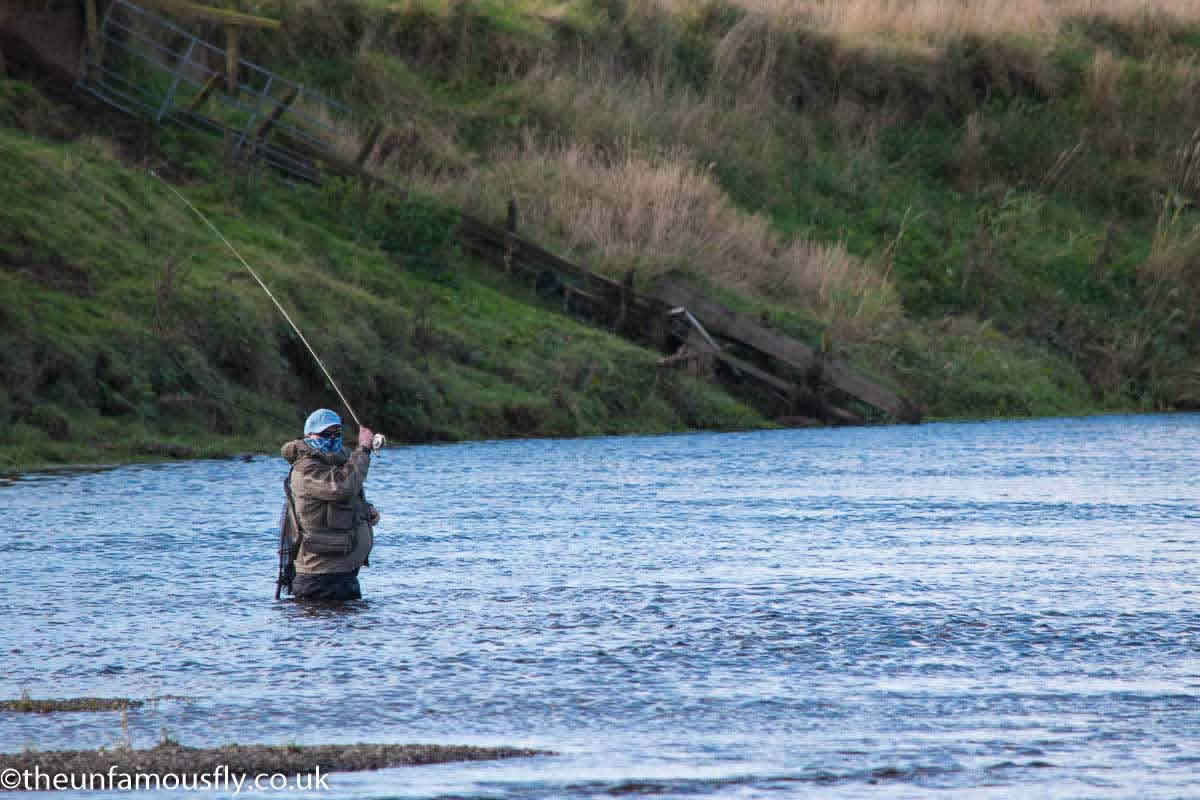
Wrapped up against the elements
Another hazard was weed which at times seemed like a tree of bush was lying submerged under the surface but I think in the main was just long strong fronds of whatever kind of aquatic plant is prevalent here, When you snagged it it took you to get hold of the line to release it.
It also proved my undoing when I felt a fish take me and it darted quickly upstream heading off at a diagonal from me. I could feel the knock, knock of its head shakes and then the line seemed to go tight. I could still feel the fish but then it all pulled free, and the fish was gone. I think one of my flies had snagged on this weed and it was enough to let the fish away.

Best fish of the outing comes to the net for John
John by this time was fishing just above me and we neither found a fish so opted to head down stream and try another bit. Again John identified a spot he had had some success at before and he went it while I watched on the bank. By now he was trying a klink with a couple of nymphs beneath to try protect the bugs from the drag of the wind. By now the wind had relented slightly and it was a little more tolerable. He soon spotted his indicator fly vanish and was in to a fish but it did not stay on as he tried to get it near for netting. Not to worry after another 5-10 minutes he had another and this time it made the net, a Grayling of about 9-10 inches probably. I then went in for another go and I eventually picked up on small grayling and John then had another just as I had decided enough was enough as the wind picked up again and the rain started to spit. If Costa coffee opened a branch near this section of the Clyde on Sunday I think I would have ended up watching from the comfy seats and having something hot with a cake instead of trying to battle the elements. Not a long outing by any means but long enough.




Was at the monument on Friday and fished the pool above it but nothing doing, went back and tried again with different nymphs and got nothing, not sure if i was doing it correctly, first go with french leader and 6ft of tippet with two flies, had to give up as my hip was giving me a lot of grief, so was heading home and spotted another angler at the so called tree pool below the monument and went down for a blether (meaning pick up some tips) ha, ha,ha, difference was he had a small float on about seven feet above his point fly, anyway he connected at the bottom of the run and had a struggle to get the grayling to the net, then we realised it was foul hooked and it broke the hook off and was gone, i am not an expert by any means but reckon it was pushing 3lb, next time i will try the trotting rod with the weighted nymphs and hopefully find it easier, if not i think i will have to give it up! lovely bit of water down there. anyway tight lines and warmer weather for you next time you are out mate.
The way I was shown (by Hywel Morgan and John Emerson) was measure a length of tippet from your foot to your wading belt. That’s the distance to your top fly, from your indicator as it would allow, with water at wading depth, for the top fly to be on the bottom. Then your second fly ( which might be your point or might be a middle dropper depending if you want to fish 2 or 3 flies) should be a distance from the dropper. This is where experts seem to vary somewhat. I think as a rule it shouldn’t be more than 2 feet between flies. But I have heard preferences of from 30cm to 45cm. I also heard, the colder the weather the closer the flies should be. Most will tell you fish the heaviest fly on point but I have heard the some express the preference of the middle fly being the heavy one. There are pros and cons.
French leader is ideal in clear water. You can use it elsewhere if you prefer, but its real benefit is in clear conditions. I have to admit I find my French Leader casts better than my nymph line.
Lob upstream from 45 degrees to almost directly above and lead it ever so slightly keeping the indicator under the rod tip and staying in contact with the flies.
Cheers for that Kenny.